
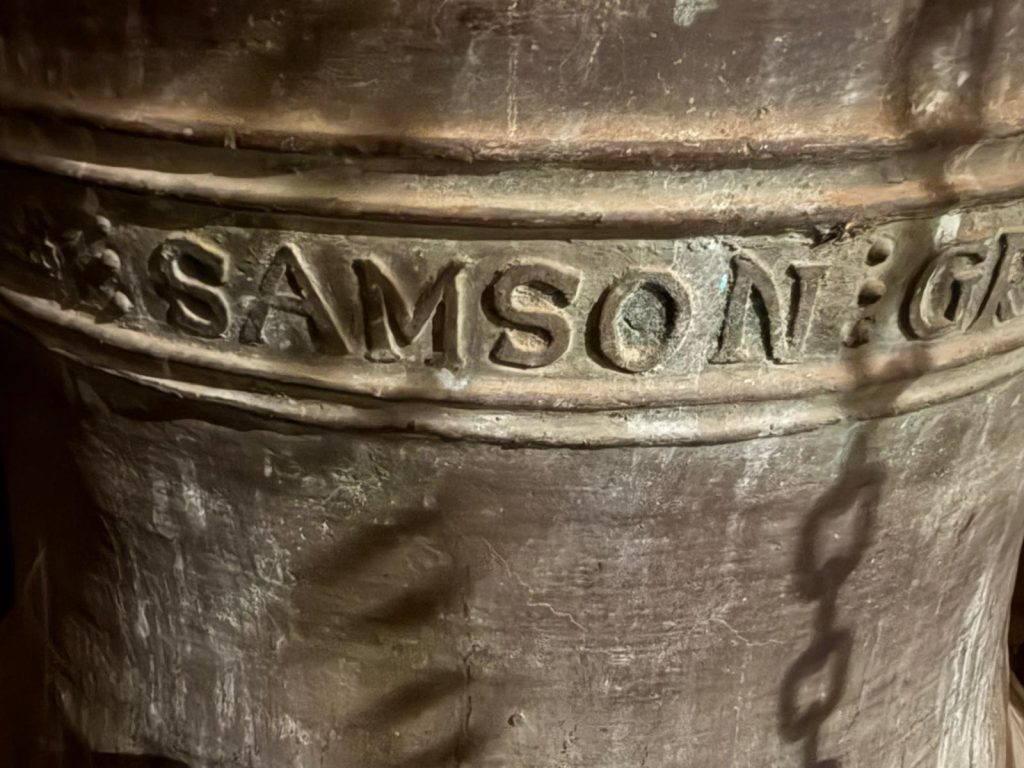
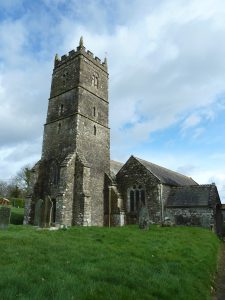
Who doesn’t love the sound of church bells? For most of us they are part of the fabric of our lives. For centuries church bells have rung out to mark personal, local and national events. St Sampson’s bells had been silent for over 50 years. But having raised over £30,000 the bells have been restored and their unique sound can be heard chiming out across the parish once again.
So what is the story of the bells of St Sampson’s Church South Hill?
As church bells go, ours are relatively old, and they are listed as “worthy of preservation”.
The four oldest bells were made (‘cast’ is the technical term) in 1698 by Devon bellfounders John Pennington of Tavistock and John Stadler of Chulmleigh. They may have been cast here, in the churchyard, which was common practice. The tuning suggests that there was probably a fifth bell, but this was replaced in 1831 by the current fifth and largest bell, the tenor, cast by William Pannell and his son Charles, of Cullompton.
The bells of 1698 probably replaced even older ones. In 1684 Sampson Manaton died and, in his will, left £10 to the Churchwardens of South Hill to be paid to them within one month after they “new cast those three bells & make them fine”. It looks as if there were already at least three bells at St Sampson’s before 1684 – and Sampson Manaton didn’t think much of them.
Originally church bells were handbells, used by early missionaries like St Sampson to call people to worship. By the late 900s most churches had hanging bells of some sort and wheel mounted bells became widespread by the late 1500s. Ringing ‘changes’, like the type of bellringing we know today, was taking place by the mid 1600s so Sampson Manaton, local gentry, perhaps wanted his church at South Hill to follow the fashion.
Sampson’s instruction to “new cast those bells” suggests that the old bells were to be melted down and made into new ones. If this was so, our existing bells retain something of the originals which were there before 1684.
Sampson Manaton’s will and the five bells give clues to stories of the parish. Each bell has an inscription recording the names of the churchwardens/priest at the time and/or those who contributed towards the cost of the bells. It is awesome to think that we are hearing what the people named on the bells in 1698 and 1831 would have heard. Written on the inside tower wall is a series of numbers, we believe this to be the “tunes” rung by the bell ringers of long ago and hope to programme our restored bells to reproduce a similar pattern.
Inscriptions on the four 1698 Pennington bells
- When I you call then follow me all (the smallest bell 27” weighing 3 ¼ cwt)
- Adam Grills Warden – John Lugger (28” bell weighing 3 ¾ cwt)
- George Matthew – Stephen Trehane – John Welke (29” bell weighing 4 cwt)
- Samson Grills – Adam ChWarden – Will Dicken (33” bell weighing 5 ¾ cwt)
Inscriptions on the 1831 Pannell bell
- Revd. E Budge – James Sowden Warden (the tenor bell , 36” diameter and weighing 7 ½ cwt – it only just fitted down the tower when the bells were removed).
We know a little about some of these men (all men!) from the parish and other records, but it would be good to find out more.
We have found very little about bellringers at St Sampson’s. The late Charles Harding of Brookfield, South Hill, organist at St Sampson’s, used to chime one of the bells until about 2010, when the PCC was advised that the bell frame was unsafe, but we don’t know when they were last rung properly. The reports from the Bellfounders told us that, although the four bells of 1698 had been quarter turned in order to bring fresh faces to the blows of their clappers , presumably when the tenor had been recast or added in 1831, the tenor bell itself had not been turned. Taylors stated that “the relatively small amount of clapper wear on the bells suggests that they have not been rung a great deal since 1831 and given their current condition, they have probably not been rung for a number of decades”. This suggestion is given weight by a wonderful 1958 article in a bellringing journal, ‘The Ringing World’ headed “Examine Unringable Bells”. It tells of an expedition to St Sampson’s by six bellringers from Truro and London who persuaded the then Churchwardens, Mr Brock and Mr Brent, to allow them access to the previously forbidden bell chamber, following the retirement of the previous Rector, Rev. Marsh. Rev. Marsh had apparently refused to allow the bells to be rung because he thought them unsafe. The intrepid bellringers carried out an inspection, did a bit of oiling of metal parts and installed new bellropes. They pronounced the bells safe and proceeded to ring “a perfect six-score of Grandsire Doubles”. The article goes on to say that “one or two curious villagers made their way to the tower, and one of the churchwardens told us that this was the first time his sixteen year old daughter had heard the bells”.
After that exciting event, we suspect that the bells remained largely or completely silent for many years.
So why were the bells taken down and what happened next?
Advice from specialists from two different bell foundries was clear. The bell frame was dangerously rotten, the bell metal in the four oldest bells was too thin to be safely tuned without cracking and even if it was attempted “the bells are so far out of tune with modern expectations that sympathetic corrective tuning would not be possible”. In other words, they would sound awful. This was very disappointing, but the advice was clear. The bells could never be rung full circle again as they had been designed to and a decision had to be made.
In December 2020 the PCC reluctantly agreed to accept expert advice that the best solution was to remove the bells from the tower, have them properly conserved and restored by bellfounders Taylors of Loughborough, fitted with new headstocks, and rehung for stationary electronic chiming.
Thanks to local fundraising and grant funding £4,800 was raised, enough to begin the process. In November 2021, with the help of a great team of volunteers, the bells were brought down from the tower. We waved them off on the back of a flatbed truck, to be stored at Loughborough on the back of a flatbed truck, wondering if we would ever raise enough money to see them restored and returned.
Four years of fundraising from grants, events and generous donations secured the money. The final piece in the funding jigsaw was a grant from the National Lottery Heritage Fund and we instructed Taylors Bell Foundry to go ahead with the work. The old cast iron crownstaples were removed, with the canons retained. A hardwood headstock and steel support framework was fitted to each bell and an internal electromagnetic hammer. The bellframe was cleaned down and reinforced and an electric spur installed in the belfry.
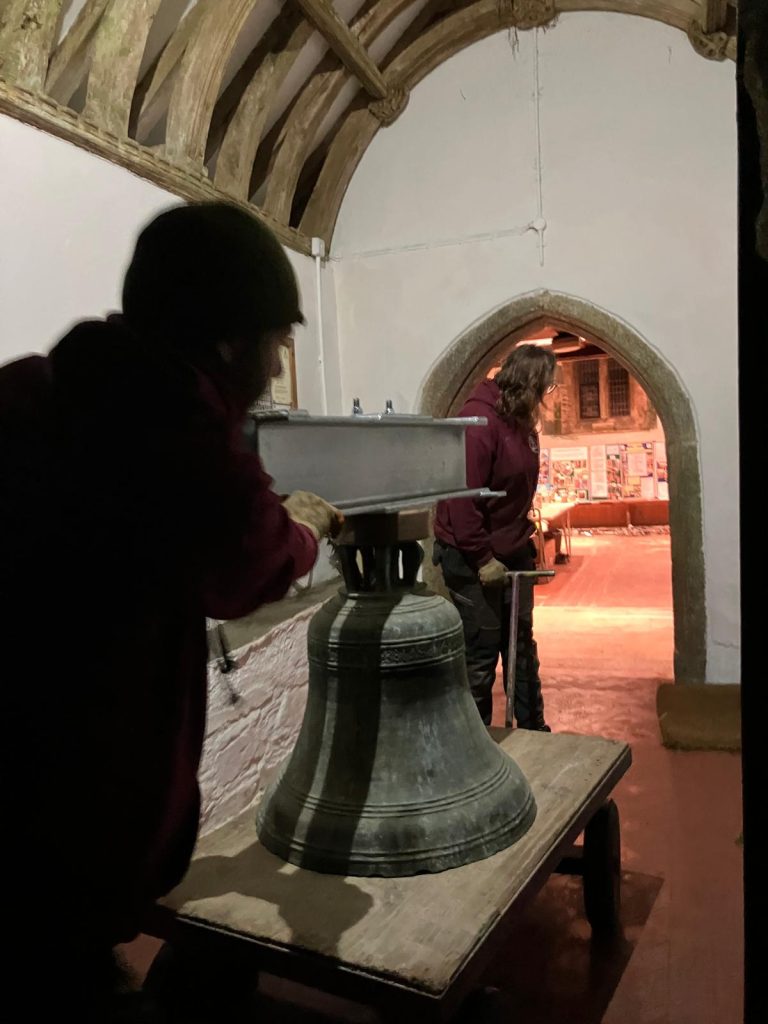
On Monday 12th January the bells arrived home to a welcome from a small crowd, including children who had waved them off 4 years previously. It was almost dark when the lorry arrived from Loughborough and the driver was astonished at being greeted by an excited welcome committee. The next day about fifty people visited to view the bells before they were hoisted back into the tower, a process which took three days with the help of volunteers guided by our bell hanging experts from Taylors. They all found it an awesome once in a life time experience. On Thursday the electronics expert wired up and programmed the bells and by Friday afternoon we could near them ringing once more. What a memorable moment hearing our special St Sampson’s bells, ringing out around the parish of South Hill once more.
The story of St Sampson’s bells unite history and technology combining the ancient with the modern; old skilfully cast bells being heard again with the aid of new technology and skills. Our old rural church reflects enduring faith and family ties across centuries. The families belong to it and it to them. The people who originally heard the bells may have seen the world differently and lived different lifestyles to ours, but they would have heard the same bells in the same place and we are proud to enable this connection through time to continue.
We are grateful for the generous support of grant funders including The National Lottery Heritage Fund, Church Care, Aurelius Trust, The Elmgrant Trust, The Sharpe Trust, Garfield Weston Foundation, individual donors, local fundraisers, and fundraising events.
By Miranda Lawrance-Owen, Judith Ayers & Caroline Beckett
stsampsonssouthhill@gmail.com
Sources for the above information:
Transcripts of parish records in Miranda Lawrance-Owen’s possession
The National Archives
‘The Church Bells of Cornwall’, Dunkin, 1878
‘The Ringing World’ 10th October 1958
‘A Short History of English Church Bells and Bell Ringing’, Central Council of Church Bell Ringers, March 2017
Reports by Taylors & Nicholsons in possession of the PCC
Correspondence from Chris Pickford, volunteer archivist at Taylors

 Palm Sunday, 25th March, St Sampson’s Church, South Hill, are planning an informal service, with a real donkey, A good natured miniature chap called Corduroy, who is a local resident. it will take place at Golberdon parish Hall at 10am We will have a short walk of witness and singing, led by the donkey, starting from outside Green Meadow, (on the road towards South Hill) to the hall, join us there or along the route, or at the hall, bring a branch to wave. This will be followed by a short friendly service, biscuit making for all ages, tea coffee and hot cross buns.
 short informal service followed by coffee, tea, juice and the best cake ever.

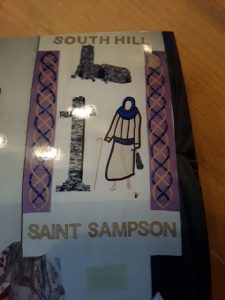 The piece makers of South Hill have kindly given St Sampson’s Church a wonderful quilt showing St Sampson. This will be gratefully received during the service on Sunday 23rd July at 11.15. and will be hung for all to see. Come and learn a bit more about who St Sampson was and what relevance he has today.